A First Baseball Inning: Follow the Outs
A first baseball inning becomes easier to read when you track outs, runners, and half-innings in order, so each change on the field makes sense.
The first baseball inning can look like a jumble of throws until you know what to follow: outs, base runners, and the half-inning’s changing sides. Start with those, and a walk, a fly ball, or a runner advancing becomes part of a readable sequence rather than a blur of activity.
What changes when a half-inning begins?
Two teams take turns batting. The visiting team bats in the top half of an inning; the home team bats in the bottom half. The batting side tries to score by sending runners around the bases and home. The fielding side tries to record three outs, which ends that team’s turn at bat.
At the beginning of each half-inning, the fielding team has no outs recorded and the bases are empty. Those are your reset points. When the third out arrives, the teams switch roles, and the new batting half starts with a fresh out count.
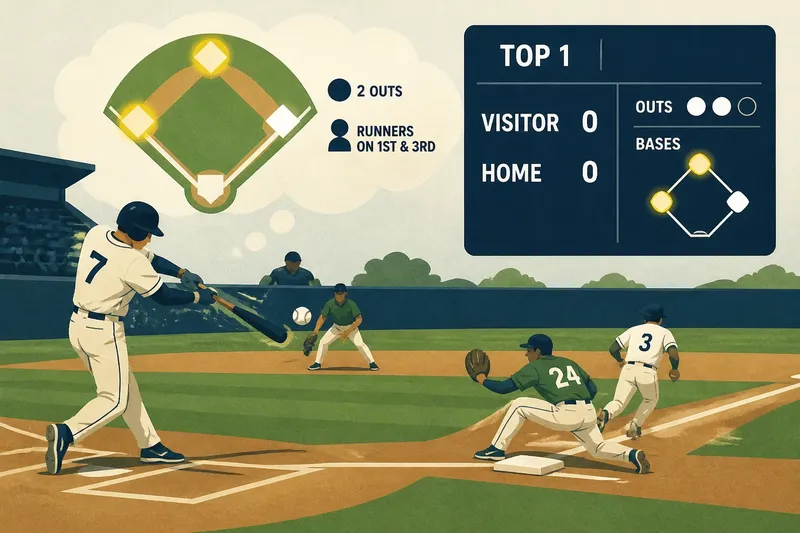
Keep the score display’s inning label in view, but don’t let the number alone tell you whose turn it is. A notation such as “Top 1” means the visitors are batting; “Bottom 1” means the home team is batting. If the home team is already ahead after the top half of the final scheduled inning, the bottom half may not be needed. For a first viewing, though, the essential idea is simply that each half ends when the fielding team gets three outs.
Watch the out count before trying to follow every fielder.
How can you track outs without losing the play?
Think of an out as a limited resource for the batting team: it gets three before the defense takes over at bat. The count may appear on a scoreboard as O or Outs, and it usually changes when the play is ruled complete. A batter can be out, or a runner already on base can be put out. Either way, the same half-inning out count advances.
Not every pitch or swing produces an out. A batter may reach base safely on a hit or a walk. A foul ball generally does not add an out once the batter has two strikes, though a caught foul fly can be an out. A strikeout is an out, and a caught ball hit in the air is an out as well. On a ground ball, a fielder may throw to a base to retire a runner or batter, depending on the play.
For a newcomer, the useful question is not “What did every player do?” but “Did the defense complete an out, and if so, how many are recorded now?” A play may include several throws and a runner moving, yet only one out may count. Some plays can produce two outs, so check the display or listen for the umpire’s signal rather than assuming one event equals one out.
What does the base-runner picture tell you?
The diamond has four bases: first, second, third, and home plate. A runner scores by advancing around the bases and touching home. Runners may occupy first, second, or third; those are the bases the scoreboard usually shows with small lights or a diamond diagram. A lit base means a runner is there.
Read the base picture alongside the out count. “Runner on first, no outs” is a different situation from “runner on first, two outs.” In the first, the defense has more chances to end the half-inning. In the second, the next out ends it, so an advancing runner may be the batting team’s last opportunity to extend the turn.
A hit can move runners, but it does not automatically send every runner the same distance. The batter-runner may stop at first while another runner advances to third. On a walk, the batter takes first, but a runner already on first is forced to move to second; other runners advance only if the bases ahead of them are also occupied. These differences explain why the diamond lights matter as much as the score.
Try saying the situation quietly: “one out, runners on first and third.” That short description keeps the important details together.
How does one invented inning unfold?
Imagine a made-up game in which the visitors begin the top of the first with the bases empty and no outs. Their first batter hits a ground ball to an infielder, who throws to first in time. That is one out; the bases remain empty. The next batter draws a walk and takes first, so the display now shows one out and a runner on first.
The following batter hits a fly ball that a fielder catches. That is the second out, while the runner remains at first. Now the next batter singles into the outfield. The runner from first advances to third, and the batter reaches first. With two outs, the picture is runners on first and third. A hit has changed the base situation, but it has not changed the out count.
The next batter hits a ground ball. The defense throws to second base, where the fielder touches the base before the runner from first arrives. That runner is out, making the third out and ending the visitors’ half-inning. The runner on third does not score on this play, so the visitors leave without a run.
Now the home team bats in the bottom of the first. The out count resets to zero, and the bases are empty. The visitors move to the field. The inning label is still “1,” but the half has changed; those are two different pieces of information.
The sequence offers a simple viewing habit: after each completed play, update the outs first, then the bases, then the score. If the half-inning ends, reset the count and base picture before following the next batter.
Why can a runner move while an out is recorded?
Baseball plays can change more than one thing at once. A runner may advance during a hit that also retires the batter, or a runner may be put out while another stays safely on base. That is why it helps to treat outs, runners, and runs as separate parts of the same play rather than as one all-purpose result.
Suppose a batter hits a fly ball that is caught. The batter is out, but a runner may try to advance after the catch. If the runner reaches the next base safely, the out count rises while the runner’s position changes. Whether the run counts can depend on when the runner touches home relative to the third out and on the kind of third out. The basic scoreboard still helps: check the final out ruling, then see whether a run was added.
Likewise, a runner can score on a play that also records an out, provided the play’s rules allow the run to count. For a first viewing, you do not need to settle every unusual timing situation in real time. Notice the umpire’s ruling and the score change; the out count and base display will show what state the game is in next.
What should you watch for during a first inning?
Use the scoreboard as a compact description of the scene, not as a substitute for watching the field. The count of balls and strikes helps explain the batter’s immediate situation, while outs and occupied bases tell you what can end the half-inning or produce a run. If the display is hard to read, listen for calls such as “strike three,” “safe,” and “out.”
- Check whether the display says top or bottom, so you know which team is batting.
- Note the out count before each pitch or major play.
- Look for lit bases after the play to locate runners.
- Watch whether a runner advances, stays put, or is retired.
- Check the score only after the play is ruled complete.
- When three outs appear, reset your attention for the other team’s half.
Say you are watching the home team with two outs and a runner on second. The batter hits a ball into the outfield, and the runner heads for home. In that invented situation, follow the runner and then check the ruling: if the runner touches home safely before the third out is completed, the score display should reflect the run; if the defense records the third out first, the half-inning ends without that score. The useful observation is the order of events, not a guess based on how close the play looked.
That is the core of a first baseball inning: the out count tells you how close the batting turn is to ending, the base picture shows who can advance or score, and the top-or-bottom label tells you which side is taking its turn. Keep those three details together, and the game’s pauses begin to feel like punctuation. The next pitch is easier to follow because you already know what is at stake.