Why a Table Tennis Rubber Has Two Sides
Table tennis rubber shapes grip, spin, speed, and control. Learn what smooth and pimpled surfaces do and how their contrast changes a player’s choices.
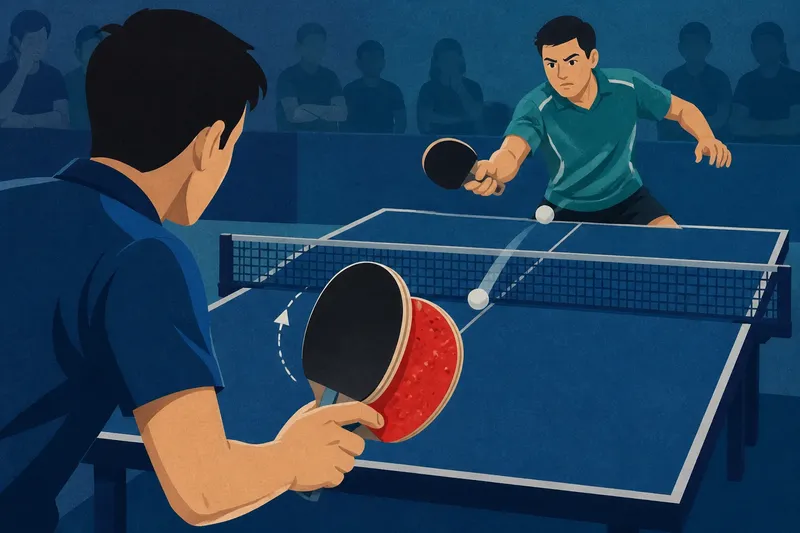
Watch a table tennis rally closely and the bat may flash from one color to another just before contact. That switch is not decoration: the two sides of a table tennis rubber can make the same incoming ball behave differently, changing how a player attacks, blocks, or disrupts an opponent.
1. What does the rubber actually touch?
A table tennis bat, often called a racket or paddle, has a blade covered by rubber. The blade supplies the underlying feel; the rubber surface is the part that meets the ball. A layer of sponge beneath the rubber may affect how the bat responds, but the visible top surface is the clearest clue to the kind of contact it can produce.
One common side has a flat, grippy surface, usually called inverted or smooth rubber. Its outward-facing sheet is continuous, with small dimples underneath it. The other side may have pimples pointing outward. Those pimples can be short, medium, or long, and their height, spacing, and firmness influence how the ball meets the bat.
Those labels describe broad families, not a promise that every rubber in one family plays identically. Still, they help explain why a player might keep two contrasting surfaces on one bat.
2. How does smooth rubber create spin?
Smooth rubber lets a player brush across the ball’s surface while making contact. That tangential friction can add topspin, backspin, or sidespin, depending on the stroke’s direction. A fast, forward brush can send a topspin ball dipping toward the table; a downward brushing action can help produce backspin that makes an opponent lift the return.
The same grippy surface also makes incoming spin matter. If a receiver angles the bat carelessly against heavy sidespin, the ball can spring sideways off the racket. Skilled players read the opponent’s stroke and adjust the bat angle, contact point, and swing rather than treating each return as a simple hit.
Smooth rubber gives a player a broad vocabulary of spin, but it asks for careful reading. The racket face and the stroke both shape the result.
3. What changes when the pimples point outward?
Outward pimples reduce the broad, continuous contact patch. Short pips are often used for direct hitting and quick counters close to the table. The contact can feel less suited to producing heavy brushing spin than smooth rubber, yet it can help a player take the ball early and strike through it with a compact motion.
Long pips can bend or flex as the ball arrives. That can soften or alter the outgoing contact, and an incoming spin may be returned with a different-looking rotation than an opponent expects. The effect depends on the ball, the stroke, and the particular rubber; “long pips reverse spin” is too simple as a universal rule.
Different pimpled rubbers create different trade-offs. A spectator can often spot a flatter, more direct counter or an unusually floating return, but the surface alone does not reveal the player’s entire technique.
4. Why put two surfaces on one bat?
The contrast gives a player two contact options without changing bats. One side might be smooth rubber for serving with spin and opening an attack; the other might be pips for blocking, disrupting rhythm, or hitting a ball early. Turning the racket at the right moment makes the choice part of the rally.
Consider an invented situation: a player receives several heavy topspin attacks with smooth rubber and keeps sending predictable blocks back. The player switches to long pips for a block; the changed contact produces a slower, less familiar return, prompting the attacker to adjust. The visible change is a different ball trajectory and a brief pause in the opponent’s attacking rhythm, not an automatic point.
A switch can also mislead an opponent about which surface made contact. Players may disguise the turn with a quick wrist movement, but the opponent can watch the bat face before and after impact and learn the pattern. The tactic works best when it supports a larger plan rather than becoming a repeated trick.
5. What can spectators read from a side switch?
Look for the racket face just before contact, then compare the ball’s flight with the player’s stroke. A smooth side paired with a brushing motion often signals an attempt to create spin. A pimpled side may accompany a compact punch, a block, or a return designed to disturb the opponent’s timing.
Next, watch the receiver’s response. A ball that appears to float, skid, or kick sideways can reveal that the contact was less predictable than expected. But do not diagnose the rubber from one odd bounce: stroke direction, bat angle, and the spin already on the ball all contribute.
- Notice whether the player turns the racket between strokes.
- Watch for a change from brushing contact to a short, direct punch.
- Track whether the opponent lifts, reaches, or mistimes the next ball.
The most useful clue is the sequence: surface choice, contact, ball flight, and opponent’s adjustment.
6. How do rubber rules affect what you see?
Players cannot simply cover both sides with arbitrary materials and call them legal equipment. Table tennis rules specify what coverings are permitted and require the racket’s sides to be distinguishable. This helps an opponent identify which surface is being used, even when the player turns the bat quickly.
Color conventions also matter to spectators: contrasting faces make a switch easier to see, while the approved covering and racket requirements keep the equipment within the sport’s rules. Exact requirements can depend on the governing rules for the competition, so a player should check the relevant rulebook and equipment approval rather than relying on appearance alone.
When following a match, focus on the visible contrast rather than trying to identify a product by color. The important question is what contact the player chooses and how the opponent handles the resulting ball.
Which table tennis rubber questions come up most?
Does smooth rubber always make more spin?
Its grippy surface is well suited to brushing the ball and producing spin, but the stroke and incoming ball matter too. A smooth side does not create heavy spin by itself.
Do long pips always reverse spin?
No. They can alter the return in ways that make spin harder to read, but the result depends on the incoming ball and how the player uses the racket. Treat “reversal” as a useful shorthand, not a rule for every contact.
Can a player switch sides during a rally?
Players can turn the racket during play and choose which face contacts the ball. Watching the bat at impact helps an opponent—and a spectator—track that choice.
Why are the two sides different colors?
Contrasting colors help identify which side is being used when a player turns the racket. That visible distinction makes the equipment choice part of the contest rather than a hidden change in contact.
What should you watch on the next point?
Follow the racket face, not just the ball. A table tennis rubber’s two sides offer different ways to meet spin, control contact, and disrupt timing; noticing the switch makes a fast exchange easier to read. Once you spot it, listen for the opponent’s adjustment: a changed bat angle or a more cautious stroke often tells you the surface has changed the problem.